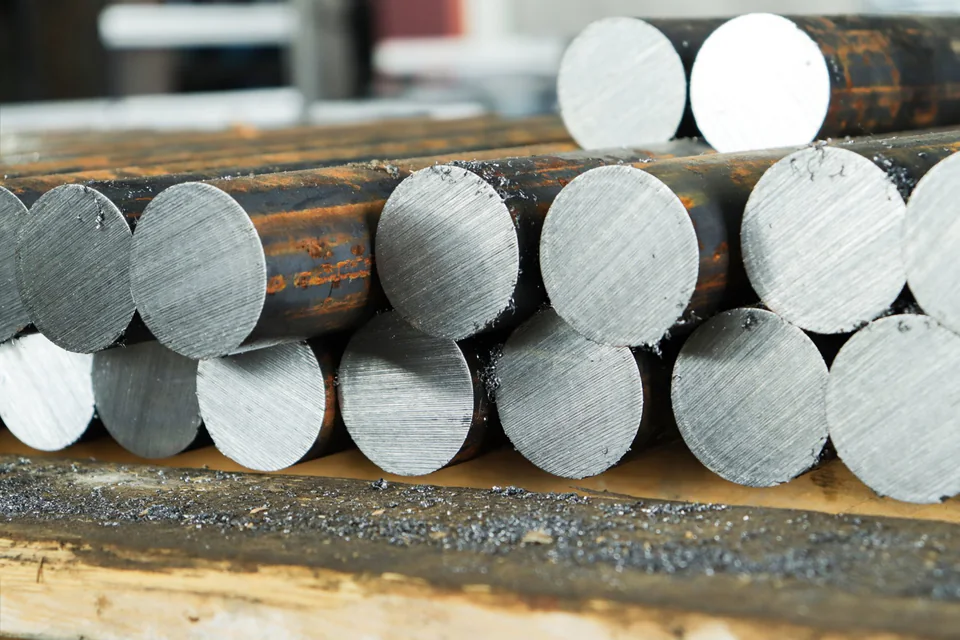
Find the Grade or Specification
Each page identifies the material family, typical processing response, common applications, and ordering points. The governing specification and purchase requirements control the order.
Buying for an aerospace or defense program? Explore 4340 VAR, 9310 VAR, 300M and 4330 modified by AMS specification and production requirement.
Carbon & Alloy Steel Bar Line Card
Keep the full grade families, supply conditions, processing capabilities, and RFQ checklist handy while you search the directory.
Find a Round Bar Grade
Search by grade, material family, or application. Each result opens a technical summary and an RFQ form with an editable grade field.
Showing 73 grades
Carbon Steel Grades
Low-, medium-, and high-carbon grades for forming, machining, forging, heat treatment, and general manufacturing.
A highly formable low-carbon steel used for headed, bent, welded, and lightly loaded production parts.
A low-carbon steel used for formed, welded, forged, and general-purpose manufactured components.
A ductile low-carbon grade used for general machining, forming, welding, and shallow case-hardening applications.
A widely used low-carbon steel valued for machinability, weldability, and consistent dimensional control.
A low-carbon machinery steel for forged, machined, welded, and case-hardened components.
A low-carbon grade commonly associated with cold heading, fastener production, and formed components.
A medium-carbon steel offering greater strength and hardness than lower-carbon general-purpose grades.
A medium-carbon grade for forged and machined components that need moderate strength and wear resistance.
A medium-carbon machinery steel offering strength, wear resistance, and heat-treatment response for loaded components.
A medium-carbon steel with a strong balance of strength, wear resistance, and machinability.
A higher-carbon machinery steel for parts that need strength, hardness, and wear resistance after heat treatment.
A high-carbon steel for components that need hardness, strength, and resistance to wear.
A high-carbon steel for heat-treated parts that need high hardness, strength, and wear resistance.
A high-carbon steel for spring action, edge retention, and wear resistance after controlled heat treatment.
A high-carbon grade used where high hardness, abrasion resistance, and spring performance are required.
A very high-carbon steel used for hard, wear-resistant parts and spring components requiring high elastic strength.
Free-Machining & High-Manganese Grades
Production-machining and manganese-modified grades used for turned parts, fasteners, forgings, and case-hardened components.
A free-machining, low-carbon steel commonly used for high-volume turned and case-hardened parts.
A medium-carbon free-machining steel for turned parts that also need strength and wear resistance.
A medium-carbon, free-machining steel used for strong production parts requiring efficient material removal.
A high-strength, free-machining carbon steel for parts that need efficient machining and good wear resistance.
A rephosphorized and resulfurized carbon steel developed for efficient screw-machine production.
A cold-finished, leaded carbon steel developed for fast, efficient machining and extended tool life.
A resulfurized and rephosphorized carbon steel designed for fast machining and good surface finish.
A low-carbon, high-manganese steel used for carburized or forged parts requiring improved hardenability and core strength.
A high-manganese carbon steel used for stronger case-hardened, forged, and machined components.
A medium-carbon, high-manganese steel for strong components exposed to repeated or heavy loading.
A medium-carbon, high-manganese steel used for heat-treated components requiring strength, fatigue resistance, and hardenability.
41XX Chromium-Molybdenum Alloys
Case-hardening and through-hardening chromium-molybdenum grades for shafts, gears, oilfield parts, and high-load machinery.
A low-carbon chromium-molybdenum alloy used for carburized parts requiring a wear-resistant case and strong core.
A low-carbon chromium-molybdenum alloy used for carburized parts requiring a hard case and tough core.
A chromium-molybdenum alloy with good strength, toughness, heat-treatment response, and weldability in the proper condition.
A medium-carbon chromium-molybdenum alloy offering strength, toughness, and through-hardening capability.
A chromium-molybdenum alloy known for strength, toughness, fatigue resistance, and heat-treatment response.
A chromium-molybdenum alloy closely related to 4140 and used for heat-treated parts requiring controlled strength and hardness.
A higher-carbon chromium-molybdenum alloy used for strong, wear-resistant, heat-treated components.
A higher-carbon chromium-molybdenum alloy for high-strength, wear-resistant, heat-treated components.
A leaded version of 4140 developed to improve machining productivity in alloy-steel production parts.
Nickel & Multi-Alloy Grades and Specifications
Nickel-, chromium-, and molybdenum-bearing grades and aerospace specifications for carburized, fatigue-critical, and high-strength applications.
A low-carbon alloy steel developed for carburized components requiring a hard surface and tough core.
A tough, high-strength nickel-chromium-molybdenum alloy used for heavily loaded and fatigue-critical parts.
A high-strength alloy steel for parts that demand toughness, fatigue resistance, and deep hardenability.
A vacuum consumable-electrode-remelted 4340 low-alloy steel specification for premium aircraft-quality round bar.
Vacuum-remelted 9310 round bar for gear and transmission manufacturing, quoted to AMS 6265 and your production requirement.
300M round bar for landing-gear and structural-component production, reviewed to AMS 6417, required condition and release schedule.
4330 modified round bar for high-strength aerospace and defense components, quoted to AMS 6411 and the complete purchase specification.
A low-carbon nickel-molybdenum alloy used for carburized parts requiring toughness and a durable wearing surface.
A nickel-molybdenum alloy chosen for carburized gears and components that need a hard case and tough interior.
A low-carbon, higher-nickel alloy used for carburized parts requiring toughness and resistance to shock loading.
A nickel-molybdenum case-hardening alloy used for tough gears, shafts, and power-transmission parts.
A low-carbon 86XX alloy used for carburized parts requiring a tough core and wear-resistant surface.
A low-carbon nickel-chromium-molybdenum alloy that develops a hard, wear-resistant case over a tough, ductile core.
A case-hardening alloy similar to 8620 with a controlled carbon range for gears and wear-critical components.
A low-to-medium-carbon 86XX alloy used for case-hardened and heat-treated components needing toughness and wear resistance.
A medium-carbon alloy steel offering good hardenability, toughness, and strength for loaded mechanical parts.
A medium-carbon alloy steel used for quenched-and-tempered components requiring strength, toughness, and fatigue resistance.
A medium-carbon 86XX alloy specified for strong, heat-treated components and controlled hardenability applications.
A medium-carbon alloy steel used for strong, heat-treated parts that require toughness, fatigue strength, and wear resistance.
A low-carbon alloy used for carburized parts that need toughness, wear resistance, and reliable fatigue performance.
A medium-carbon alloy used for high-strength, heat-treated parts requiring toughness and resistance to fatigue.
A premium case-hardening alloy used for highly loaded gears and components requiring exceptional core toughness and fatigue strength.
A medium-carbon alloy used for quenched-and-tempered components requiring strength, toughness, and through-hardening response.
Spring, Bearing & Wear Grades
Chromium and chromium-vanadium grades for springs, bearings, rolling contact, and wear-resistant parts.
A low-carbon chromium alloy used for carburized parts requiring improved hardenability and wear resistance.
A medium-carbon chromium alloy used for strong, wear-resistant parts and spring components.
A chromium alloy spring steel known for toughness, fatigue resistance, and high strength after heat treatment.
A high-carbon chromium steel used for bearings and precision wear components requiring hardness and rolling-contact fatigue resistance.
A chromium-vanadium alloy spring steel used for high-strength parts exposed to repeated flexing, impact, and fatigue.
ASTM, Bolting & Anchor Specifications
Structural, forging, bolting, and anchor-bolt requirements where the governing ASTM grade and finished-product details control the order.
A widely used structural carbon steel specification for general fabrication and load-bearing applications.
A high-strength low-alloy structural steel specification available in several strength grades.
An ASTM carbon steel forging specification used for pressure-system flanges, fittings, valves, and related components.
A chromium-molybdenum alloy bolting grade used for high-temperature and high-pressure service.
A heat-treated chromium-molybdenum-vanadium alloy bolting grade for demanding high-temperature service.
An ASTM anchor-bolt specification covering several strength grades for structural anchoring applications.
The lower-strength ASTM F1554 anchor-bolt grade used for general structural anchoring and fabricated anchor assemblies.
A medium-strength ASTM F1554 anchor-bolt grade used where higher yield strength is required for structural anchoring.
The high-strength ASTM F1554 anchor-bolt grade used for demanding structural and equipment anchoring applications.
Need a Different Grade?
If the grade is not listed, send the drawing designation or complete material specification with the size, condition, quantity, and delivery requirement.
Request a Quote