1045 vs. 1144 Steel: Round Bar Comparison for Production Machining
1045 is a medium-carbon steel used across machining and heat-treatment routes. 1144 is a resulfurized carbon steel selected when production machinability is a primary requirement.
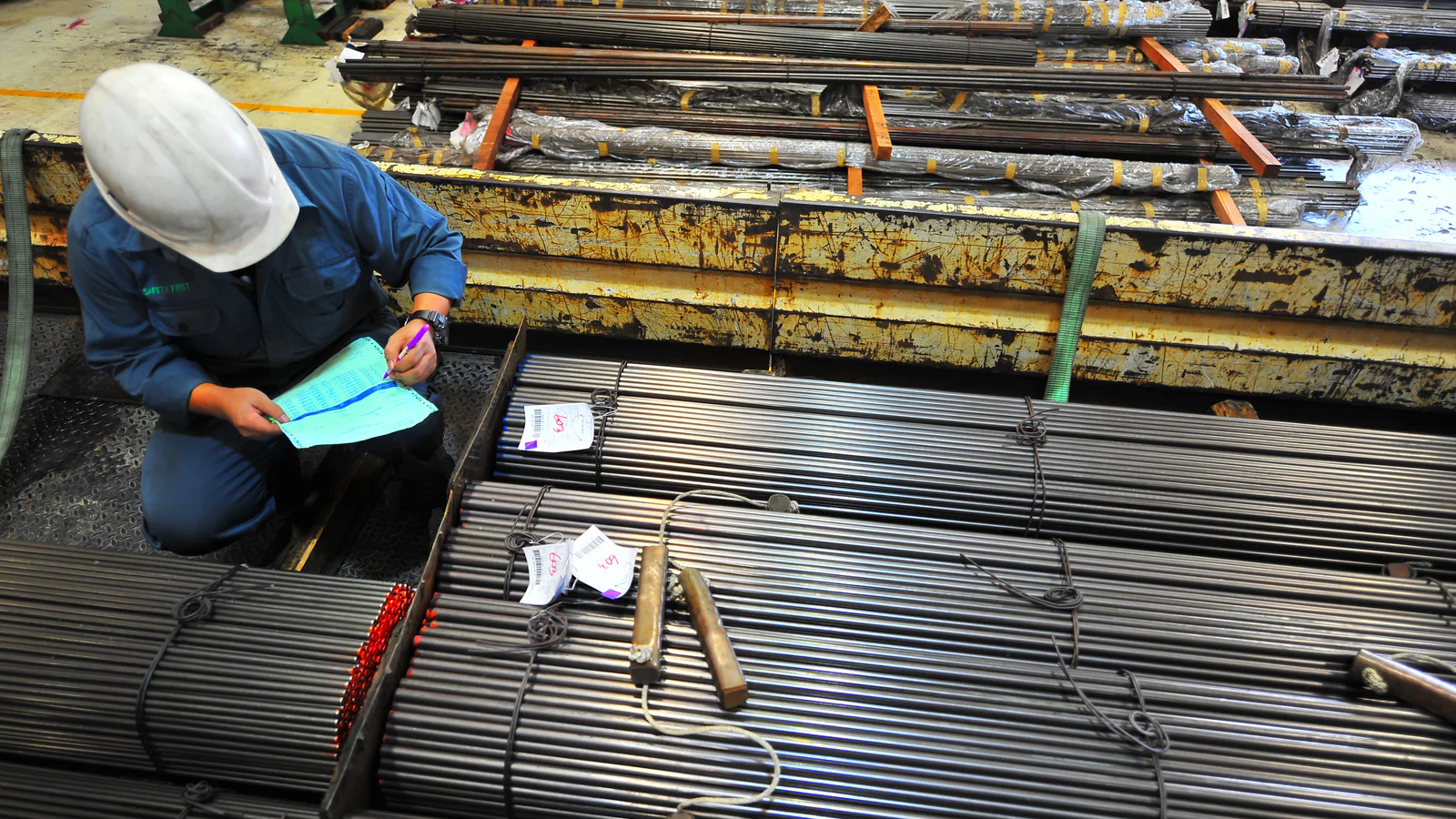
The practical difference is manufacturing priority. 1045 is a medium-carbon steel commonly evaluated for strength and heat-treatment response. 1144 is a resulfurized carbon steel commonly evaluated when chip control and production machinability are major cost drivers.
Neither grade is a universal replacement for the other. The design must account for loading, fatigue, heat treatment, welding, transverse properties, section size, and the delivered bar condition.
Buyer takeaway: Consider 1144 when machining throughput and chip behavior justify a resulfurized grade and the design accepts its property profile. Consider 1045 when the part needs a more conventional medium-carbon route for forging, welding review, or hardening. Approve the exact grade and condition before quoting truckload volume.
1045 vs. 1144 at a glance
| Decision | 1045 round bar | 1144 round bar |
|---|---|---|
| Grade type | Medium-carbon steel | Resulfurized carbon steel |
| Primary buying reason | Strength and heat-treatment potential | Production machinability and chip control |
| Heat treatment | Commonly evaluated for normalizing, Q&T, or localized hardening | Often purchased for machining in a defined supplied condition; heat-treatment route needs specific review |
| Welding | Requires condition- and section-specific procedure review | Resulfurized chemistry makes welding suitability a more restrictive engineering question |
| Product-form issue | Hot-rolled and cold-finished routes differ | Commercial properties often depend heavily on cold-drawn or stress-relieved product route |
| Common mistake | Assuming one generic 1045 property value | Treating every 1144 bar as a trademarked stress-relieved product |
Why 1144 machines differently
SAE J403 identifies the chemistry requirements for SAE carbon-steel grades. 1144 is intentionally resulfurized. In a controlled microstructure, manganese-sulfide inclusions can improve chip formation and reduce cutting forces in many production operations.
That does not guarantee the same machining result from every product. Tooling, speed, feed, depth of cut, hardness, microstructure, cold work, bar straightness, surface, and lot consistency still matter.
For a high-volume machining program, test the grade in the actual supplied condition and track:
- cycle time and tool life;
- chip length and evacuation;
- surface finish and dimensional stability;
- bar-feed performance and straightness;
- cutoff loss and usable yield;
- movement after heavy or asymmetric machining.
Do not use “Stressproof” as a generic synonym
StressProof® is a proprietary trade name associated with a controlled cold-drawn, stress-relieved product. A request for SAE 1144 chemistry does not automatically specify that proprietary product or its mechanical-property package.
If the drawing requires a trademarked product, cite the exact designation and current producer requirements. If it requires generic 1144, state the product standard, supplied condition, mechanical properties, straightness, and tolerances without assuming trademark equivalence.
Which grade is stronger?
There is no condition-free answer. Cold work and stress relief can give a 1144 bar a very different delivered property level from hot-rolled or annealed 1045. Conversely, heat-treated 1045 may be specified to a property package that an as-supplied 1144 order does not meet.
Compare actual purchase scopes:
- grade and product standard;
- hot-rolled or cold-finished condition;
- diameter and test location;
- required tensile, yield, elongation, reduction of area, and hardness;
- longitudinal versus transverse property relevance;
- straightness and residual-stress controls.
Heat treatment, fatigue, and welding
1045 is commonly considered for induction-hardened surfaces or other controlled heat-treatment routes. 1144 may serve effectively in many machined components, but the inclusion structure that supports machinability must be considered when fatigue, impact, transverse loading, or severe forming controls the design.
Welding should be addressed before material purchase. The higher carbon of 1045 already requires a qualified procedure. The resulfurized chemistry of 1144 adds a separate concern; it should not be assumed weldable because another carbon steel was used successfully.
Product form and tolerance can decide the economics
ASTM A108-24 covers cold-finished carbon and alloy steel bars and includes dimensional and supplementary requirements. ASTM A576-25 covers hot-wrought special-quality carbon bars. The four-digit grade name alone does not select one route.
For screw-machine, CNC turning, or bar-fed production, compare:
- usable diameter tolerance and ovality;
- straightness over the required bar length;
- surface discontinuity and decarburization limits;
- end condition and bar-feed requirements;
- cleanup stock and finished-part yield;
- mechanical-property consistency by size.
RFQ checklist
Provide:
- 1045 or 1144 plus the governing specification and revision.
- Hot-rolled, cold-drawn, turned, ground, stress-relieved, or other condition.
- Diameter, length, total quantity, release size, and quantity tolerance.
- Required mechanical properties, hardness, and test basis.
- Diameter, straightness, surface, decarburization, and end requirements.
- Machining process, bar-feed context, and critical finished features.
- Heat treatment, welding, or fatigue-critical service information.
- MTR, traceability, marking, delivery, and ship-to requirements.
Review the 1045 and 1144 grade pages. For a defined production program, send the complete material and delivery scope through Request Pricing.
Source Record
Primary and industry sources reviewed for this article:
- SAE J403_202402: Chemical Compositions of SAE Carbon Steels SAE International · Accessed August 13, 2026
- ASTM A108-24: Steel Bar, Carbon and Alloy, Cold-Finished ASTM International · Accessed August 13, 2026
- ASTM A576-25: Steel Bars, Carbon, Hot-Wrought, Special Quality ASTM International · Accessed August 13, 2026
Carbon & alloy round bar
Quote the Exact Material Requirement
Send the grade or specification, diameter and length, supply condition, quantity, testing, required date, and ship-to location for review.
Request a Quote